Automatic & Mechanical Watches
An automatic watch is a miniature machine that runs on the motion of your wrist — no battery, no circuit board. This page explains what actually separates one automatic from another (the caliber, power reserve, accuracy, crystal and water resistance), shows the automatics we link to on Amazon.com, and points you to the guides that answer the questions owners ask most.
What to Look for in an Automatic Watch
Movement Caliber
The caliber decides serviceability and behavior. Seiko 4R36/NH36, Orient's in-house calibers and the Swiss Powermatic 80 are all well-documented workhorses with parts available worldwide. Unbranded movements are not necessarily bad, but harder to service.
Power Reserve
Most entry-level automatics store roughly 40 hours of energy — enough for a night on the nightstand, not for a weekend. The Powermatic 80 stores up to 80 hours. If you rotate several watches, this spec matters more than any other. Power reserve explained →
Accuracy
Manufacturers specify entry-level calibers at roughly -20/+40 seconds per day; Swiss calibers are often tighter, and COSC-certified chronometers must hold -4/+6. A watch outside its spec can usually be regulated. How accurate should it be? →
Crystal Type
Mineral crystal is standard at the entry level and will collect fine scratches over the years; sapphire (Mohs 9) is close to scratch-proof and typical on Swiss watches. Sapphire vs mineral →
Water Resistance
30m is splash-proof, 100m is fine for swimming, 200m is dive-watch territory. Match it to your life rather than paying for a rating you will never use. Ratings explained →
Hacking & Hand-Winding
Hacking stops the seconds hand when you pull the crown so you can set the time precisely; hand-winding lets you restart a stopped watch in seconds. Every caliber in our catalog offers both. How to wind an automatic →
The Calibers Behind Our Picks
Three movement families cover every automatic we link to. The figures are the manufacturers' published specifications, not our own measurements.
| Caliber | Found in | Beat rate | Power reserve | Hacking / hand-wind |
|---|---|---|---|---|
| Seiko 4R36 (sold to other brands as NH36) and NH35 | Seiko 5 Sports, Invicta Pro Diver | 21,600 bph | approx. 41 h | Yes / Yes |
| Orient in-house (F6724 family) | Orient Bambino | 21,600 bph | approx. 40 h | Yes / Yes |
| Swiss Powermatic 80 | Tissot PRX | 21,600 bph | up to 80 h | Yes / Yes |
Seiko, Orient or Tissot — Which Direction?
Seiko is the sport-watch route: the 5 Sports line puts the 4R36 caliber in a robust 100m case with a rotating bezel and day/date. It is the watch to wear every day without thinking about it, and the easiest automatic to have serviced anywhere in the world.
Orient (part of the Seiko Epson group) builds its own calibers and uses them in the Bambino, a slim dress watch with a domed crystal and leather strap. It is the office and formal-wear route and the usual answer to "which dress watch should I start with".
Tissot is the Swiss route. The PRX pairs an integrated steel bracelet and sapphire crystal with the Powermatic 80, whose 80-hour reserve means a watch left on the dresser from Friday evening is still running on Monday morning. It costs a tier more and is the natural step up once you know you enjoy mechanical watches.
Not sure whether you want a mechanical watch at all? Read automatic vs quartz first, or the plain-English watch movements explained. If a listing says "quartz movement" and you are wondering what that means, see quartz movement explained.
Automatic Watches on Amazon.com — One Per Style
Three starting points: a sport automatic, a dress automatic and a Swiss automatic. Every dive and dress watch in our catalog is also an automatic — browse Diver & Sports and Dress & Designer for the full selection.
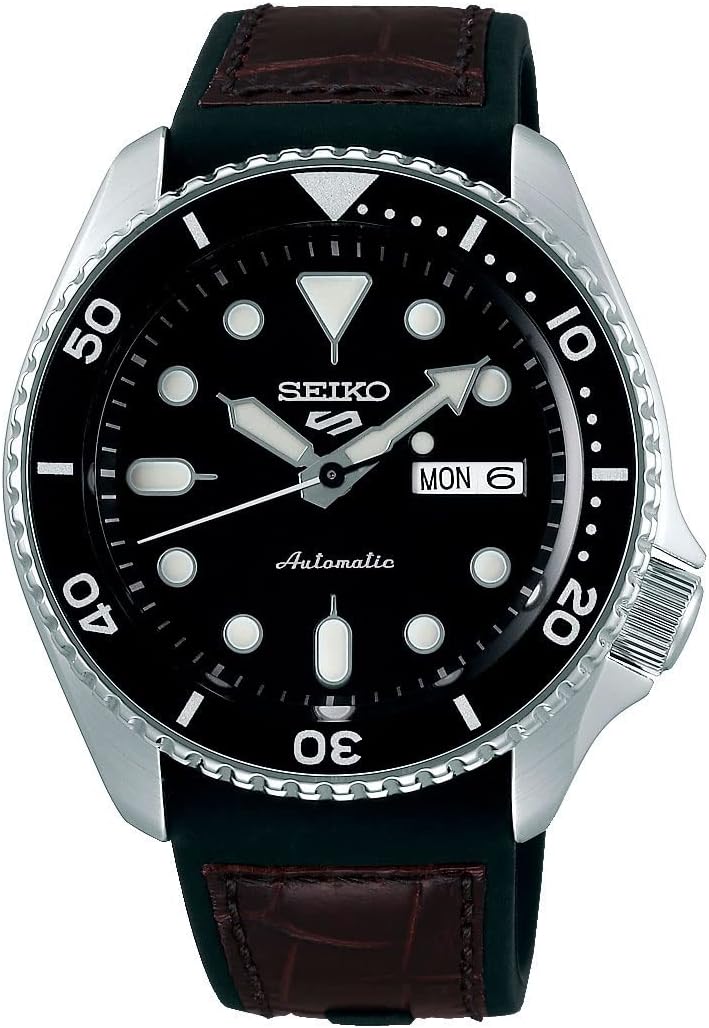
Seiko 5 Sports SRPD83K1 Automatic Watch — Black Dial, Nylon Strap, 100m WR, Day/Date
$89.95
Price on Amazon.com at time of retrieval; taxes and shipping may apply

Orient 2nd Gen Bambino Ver. 2 Automatic Dress Watch for Men — Japanese Automatic, Leather Band
$179.00
Price on Amazon.com at time of retrieval; taxes and shipping may apply

Tissot PRX Swiss Automatic Watch for Men — Blue Dial, Stainless Steel Integrated Bracelet, 40mm
$595.00
Price on Amazon.com at time of retrieval; taxes and shipping may apply
Owning an Automatic — The Questions That Come Up
- My automatic runs fast or slow — is that normal?
- Why did it stop overnight? Power reserve explained
- How to wind and set an automatic watch
- Watch winders and the right TPD setting
- When does an automatic need a service?
- Daily care, cleaning and magnets
- 7 things to check before buying
- First serious watch: budget tiers and what each buys