Watch Styles — 2026
GMT Watches Explained:
Two Time Zones on One Watch
GMT — Greenwich Mean Time — is the reference time zone used in aviation and navigation. A GMT watch adds a second hour hand that tracks a second time zone simultaneously, making it one of the most practically useful complications for anyone who works or travels across time zones.
The Origin: Pan Am and Professional Aviation
The modern GMT watch was developed in partnership with commercial aviation in the 1950s. As commercial airlines began transatlantic service, crews needed to track both local time and reference time simultaneously — local time for operational awareness, reference time (Greenwich Mean Time) for navigation and communication with other aircraft and air traffic control. The GMT complication was the solution: a dedicated 24-hour hand tracking reference time against a 24-hour bezel.
How a GMT Watch Works
A GMT watch adds a fourth hand to the standard hour, minute and second display. This additional hand — typically shorter or differently colored from the main hour hand — completes one revolution every 24 hours instead of every 12. It's read against a 24-hour scale, either on a rotating bezel or printed on the dial's chapter ring.
Setting the GMT: you set the main hour and minute hands to local time in the usual way. The GMT hand is set separately to the reference time zone (typically 24-hour UTC or your home time zone when traveling). Once set, both local and reference time are visible simultaneously at a glance.
Flyer GMT vs Caller GMT — An Important Distinction
There are two functionally different types of GMT watch, and the distinction matters:
Flyer / Traveler GMT ("True GMT")
In a flyer GMT — often called a "true GMT" — the local hour hand can jump independently in one-hour increments while the minute hand and GMT hand stay fixed. To set local time in a new time zone, you simply jump the main hour hand by the hours' difference. This is the professional tool watch implementation designed for frequent travelers: the GMT hand keeps tracking your reference or home time zone undisturbed while you adjust local time on the fly.
Caller / Office GMT (Independent GMT Hand)
In a caller GMT — also called an office GMT — the GMT hand itself is set independently from the main hour hand. You set the GMT hand to the second time zone you want to track (a colleague's or client's time zone, for example), and your main hands stay on local time. This layout suits people who stay in one place but regularly deal with another time zone — hence "caller": a glance tells you whether it's a reasonable hour to call.
Reading the 24-Hour Scale
The 24-hour bezel or scale lets you distinguish AM from PM on the GMT hand — a practical consideration since a 24-hour hand can only point to one place on a 12-hour dial. Reading the GMT hand against the 24-hour scale directly tells you: if the GMT hand points to 14, it's 2pm in the reference time zone. If it points to 02, it's 2am.
Bezels come in two configurations: bi-directional (you can set the 24-hour scale to any reference) and fixed (the scale is printed and the GMT hand simply tracks the set reference time). Rotating bezels add flexibility but require care not to accidentally move them.
Do You Actually Need a GMT Watch?
A GMT watch is most useful if you:
- Travel internationally regularly and need to track home time
- Work with colleagues, clients or partners in a different time zone daily
- Are a pilot, navigator or in any profession tracking multiple time zones
If you rarely cross time zones, the GMT complication is largely decorative — an additional visual element on the dial rather than a functional tool. That said, the aesthetic of a GMT watch with its four-hand layout and 24-hour bezel is visually compelling and has made the category popular beyond purely practical users.
GMT Watches in Context
GMT watches occupy a space between tool watch functionality and dress watch sophistication. They're typically more understated than dive watches but more capable than pure dress watches. Many collectors consider a GMT the most versatile watch in a rotation — equally appropriate in a business meeting or at an airport.
For more on watch complications, see our complete complications guide. For related travel functionality, our sizing guide covers what to consider for a watch you'll wear everywhere. Browse all watch guides.
Browse automatic watches with functional complications.
Browse Automatic WatchesRecommended Dive & Sports Watches

Invicta Men's Pro Diver 8926OB Automatic Watch — Coin-Edge Bezel, Stainless Steel Bracelet
$62.73
Price on Amazon.com at time of retrieval; taxes and shipping may apply
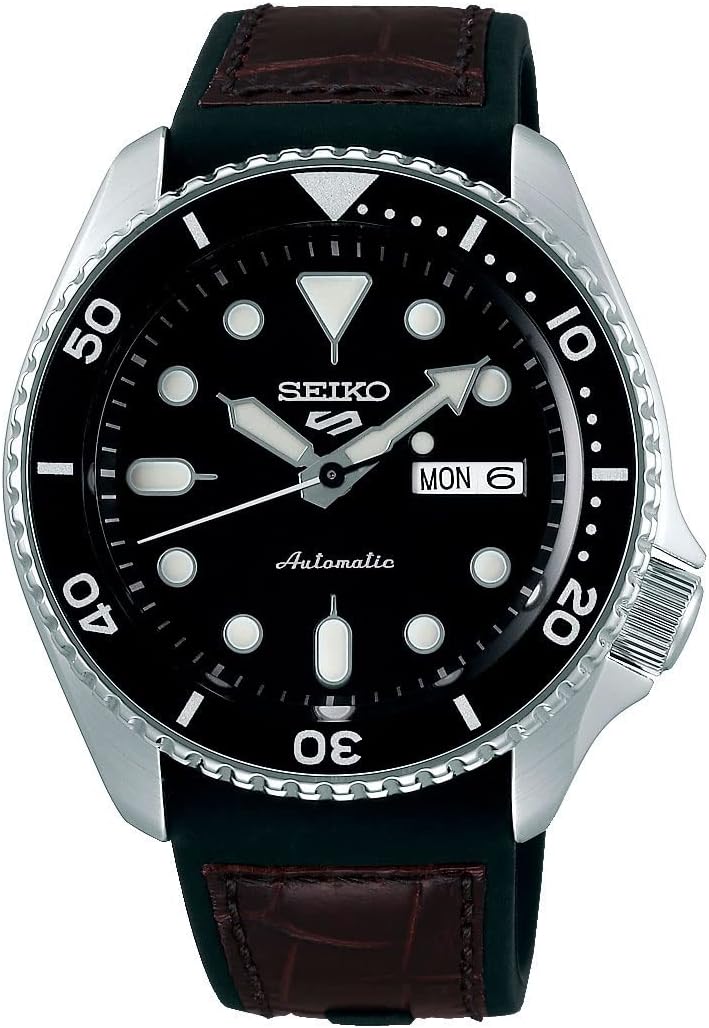
Seiko 5 Sports SRPD83K1 Automatic Watch — Black Dial, Nylon Strap, 100m WR, Day/Date
$89.95
Price on Amazon.com at time of retrieval; taxes and shipping may apply
Dive & Sports Watches
Compare our top dive and sports watch picks with buying guidance.
View Dive & Sports Watches